
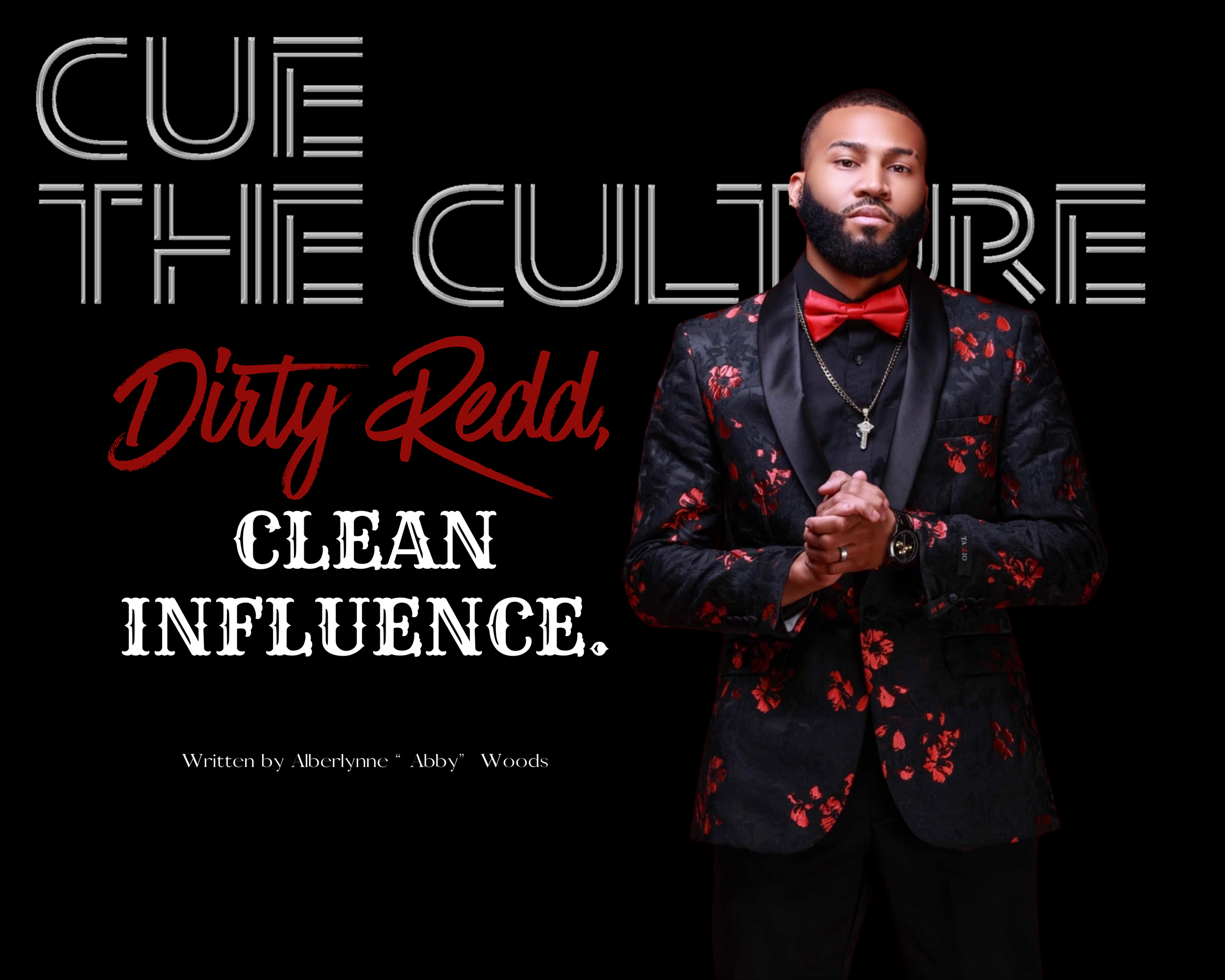
Dirty Redd, Clean Influence.
Written by Alberlynne “Abby” Woods
Before I ever met DeMarcus Adams, I felt like I already knew him.
That’s the strange gift social media can sometimes give.
In 2020, I packed up a career in Los Angeles built around branded content, entertainment and storytelling and landed in Carthage, Mississippi to help care for my aging in-laws. Like so many others, I found myself in a place where the world had suddenly stopped. There were no networking events. No festivals. No traffic. No coffee shops buzzing with conversation. I had moved more than 1,800 miles from home, and just as I was preparing to introduce myself to my new community, the community was forced to disappear behind closed doors.
So I did what I knew how to do.
I began to write.
What eventually became Cue The Culture was born in Leake County during one of the loneliest moments in modern history. At first, I reached back toward the people I already knew and had the pleasure of working with. They were familiar and graciously took my call.
Somewhere along the way, Mississippi kept interrupting my algorithm.
One creator in particular kept showing up. That creator was DeMarcus Adams. He’s a truck driver from Leake County who somehow manages to make people laugh without ever looking like he is ever trying too hard.
Before sunrise, he is hauling freight across highways that stretch far beyond Mississippi. Somewhere between deliveries, he finds time to record videos, edit content and keep showing up online with a consistency that would exhaust most full-time creators.
He laughs when he admits that he originally became more consistent after discovering social media could actually pay him.
He kept creating.
Not because of the money, but because people began telling him that his videos helped them through difficult days.
“If I know I go to your page,” strangers tell him, “I know I’m going to smile.”
That changed everything.
Adams said, “I don’t even care if I get paid anymore. I know somebody out there wants to laugh.”
His content has become part of the rhythm of life across Leake County and surrounding communities. His ongoing “beef” with neighboring Kosciusko has become a running joke that residents on both sides secretly enjoy. His sports commentary has made him a familiar face at high school games. He’ll throw on one of his signature wigs, always reminding everyone they’re men’s wigs, not women’s, before launching into another perfectly timed character.

Dirt Redd posing with two middle school basketball girls and a trophy
His comedy doesn’t rely on expensive production or elaborate sketches. It doesn’t make fun of life in rural or small town communities. His comedy has become a source of joy, belonging and being proud of Leake County.
Perhaps nowhere is that more evident than his ongoing admiration for Miss. Hattie at JR Food Mart that sits in the center of Carthage where HWY 35 and HWY 16 meet.
Online, he’ll jokingly proclaim his love for her legendary chicken and her unmistakable personality. Behind the laughs is genuine affection. Every chance he gets, he stops by to check on her because, as he told me, too many people have forgotten to check on their elders.
One of his biggest dreams isn’t buying himself something extravagant.
It’s buying Miss Hattie a food truck so she can work because she wants to, not because she has to.
That tells you everything about the man behind the jokes.
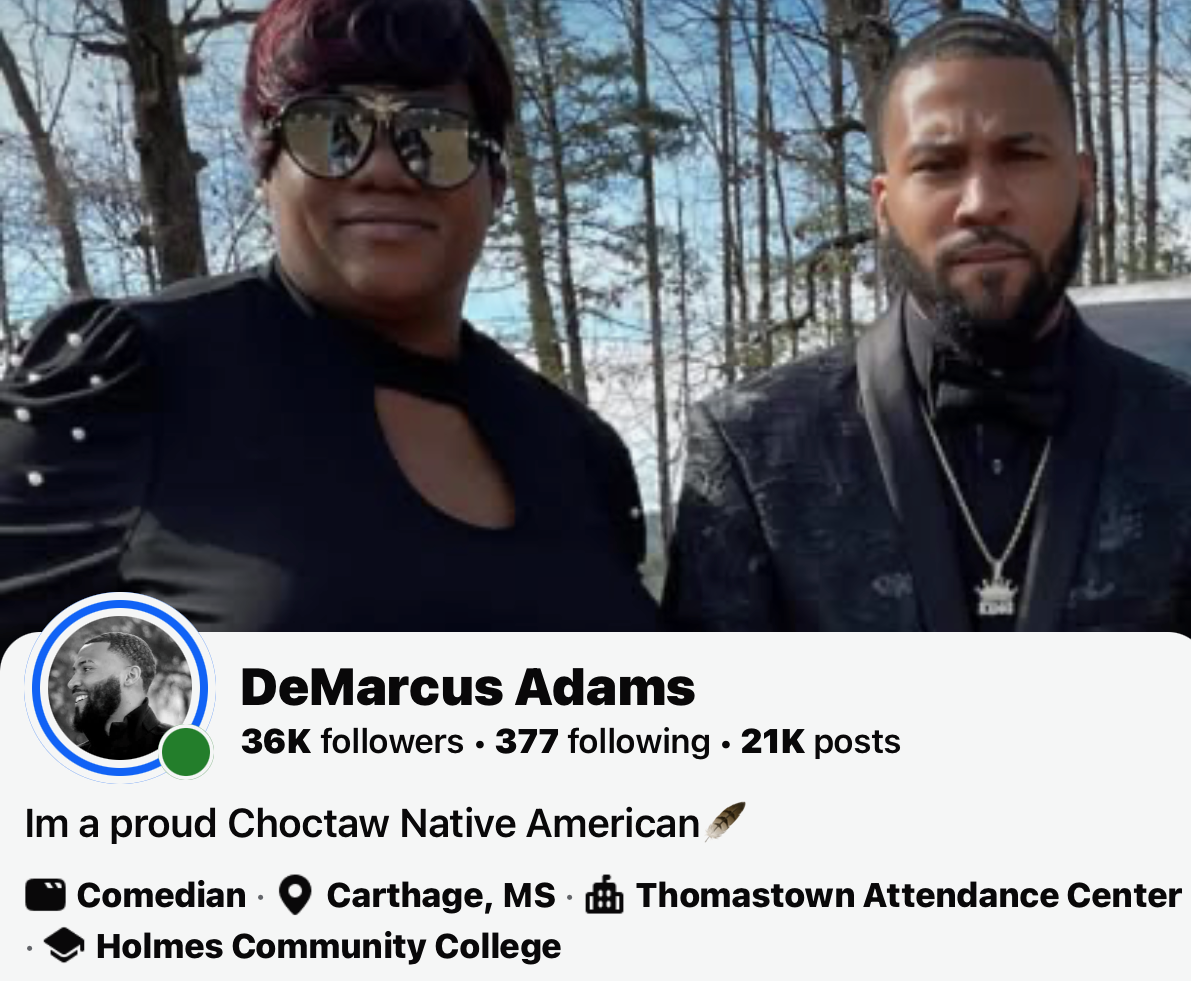
Another running gag is his playful insistence that he has Mississippi Band of Choctaw heritage. What started as comedy unexpectedly became something much more meaningful. It introduced thousands of followers to a community many knew very little about. Along the way, Adams himself developed a genuine appreciation for the history and culture of the Mississippi Band of Choctaw Indians, creating conversations that extended well beyond a punchline.
Watching DeMarcus’ humor evolve into genuine friendships proves that laughter has always been one of the South’s oldest forms of diplomacy.
The joke opens the door.
Respect keeps it open.
That philosophy seems to define much of DeMarcus’ life.
Raised between Memphis,TN and Thomastown, MS Adams speaks candidly about growing up poor, experiencing homelessness and reconnecting with his father as an adult after years apart. Those experiences shaped him in profound ways. They also explain why he pours so much into his own wife and daughter and why he is determined to be the father he didn’t always have.
His wife, his high school sweetheart, remains his biggest supporter. He proudly celebrates her military service and the sacrifices she continues to make. When asked about supporting local students, his answer comes without hesitation.
“I just want them to know somebody cares.”
Maybe that’s why you’ll find him at football and basketball games cheering on teenagers who may never realize the impact those moments have on him. He remembers what it felt like not having many people in the stands cheering for him. Now he proudly fills that gap for somebody else.
His content is also remarkably clean.
That isn’t accidental.
Years ago, after hearing a guest preacher deliver a sermon that challenged everything about the way he was living, Adams says he walked out of church a different man. He stopped cursing. He changed the way he treated people. While still being proud of the nickname, Dirty Redd, Adams will quickly tell you he isn’t perfect. The decision to keep it clean has allowed families across Mississippi to enjoy his content together without hesitation.
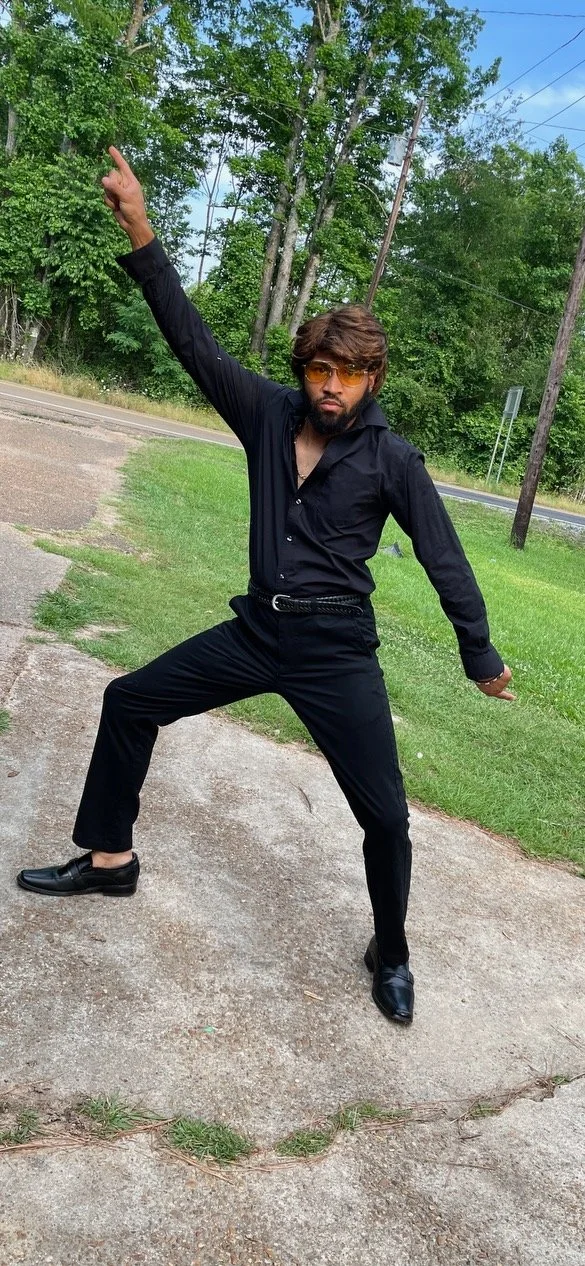
Dirty Redd doing a dance move in a silly outfit
In today’s creator economy, where outrage often outperforms kindness, that feels almost revolutionary.
During our conversation, I asked Demarcus what he ultimately wanted.
His answer was immediate.
“I just want to be famous.”
It was such an honest answer.
Maybe, just maybe, in chasing fame, DeMarcus Adams has already found something far more meaningful. He’s become proof that influence can begin in a truck, with a phone in one hand, a joke in the other and a heart determined to make an entire community feel seen, valued and impossible to ignore.