NaJé: The Sound of Truth, The Discipline of Thought
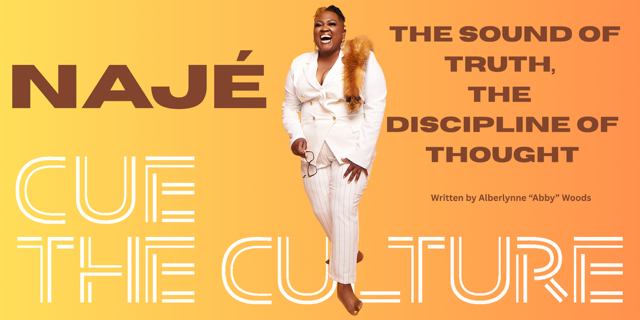
Written By Alberlynne “Abby” Woods
There is something unmistakable about NaJé.
It is not just her voice, though that alone has the power to stop a room mid conversation. It is not just her story, though it stretches from small town beginnings to viral moments that ripple across timelines and into living rooms around the world. What makes NaJé unforgettable is the way she thinks. The way she processes. The way she refuses to separate intellect from instinct, faith from freedom, or artistry from accountability.
And if I am honest, it is also the reason I understand her.
As a Black woman who has spent a lifetime being labeled many things before being understood, I recognize the tension of moving through the world as both deeply intellectual and deeply creative. People try to figure you out. They attempt to categorize you, simplify you, define you in ways that make them comfortable. But the truth is far more complex. The truth is that some of us are not meant to be fully understood by people. Only God holds that authority.
NaJé lives in that truth.
Before the name, there was NaQuita JeNae Elmore. Before the platform, there was a young woman navigating spaces that did not always know what to do with her brilliance. And before the viral moment that would introduce her to a national audience, there was a 19 hour shift at a Texas jail, a tired body on a couch, and a simple, unplanned decision to record a TikTok.
That video, built from nothing more than her authentic self, became everything.
“I had no expectation,” she recalls. What followed was a cultural moment. A phrase. A feeling. A sound that people across the country and across industries could not help but repeat.
The TikTok that went viral was her spontaneous video built around the phrase and melody of “Go Lay Down.”
She recorded it after a long 19-hour shift, sitting on her couch, exhausted and just being herself. There was no strategy, no rollout, no expectation. She simply started saying and singing “go lay down” and posted it.
By the next day, it had taken off.
What made it viral wasn’t production or planning. It was the tone, the delivery, and the honesty. People connected to it instantly and began recreating it, turning it into a nationwide moment. Celebrities and everyday users alike joined in, each doing their own version.
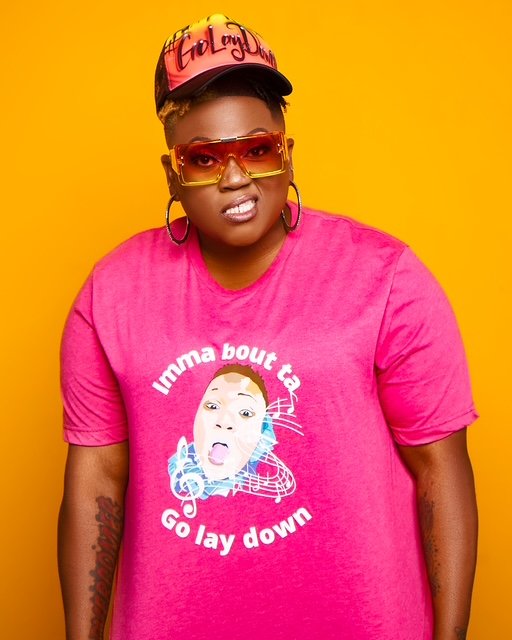
It became more than a video. It became a cultural phrase, almost like a modern-day call and response rooted in humor, truth, and a little bit of church cadence.
And that’s the key. Even though she wasn’t intentionally making something spiritual, people felt something in it. That authenticity is what made it travel.
But NaJé is not interested in virality for virality’s sake. That moment did not turn her into a content machine. It clarified something deeper. People were not responding to performance. They were responding to truth.
And truth, for NaJé, is layered.
It is rooted in a childhood shaped by contradiction. Raised in environments that prioritized proximity to whiteness as a pathway to advancement, she found herself confronting racism early and often while simultaneously excelling intellectually in those same spaces. That tension did not diminish her. It sharpened her. It forced her to ask questions. It demanded that she define herself before the world could attempt to do it for her.
That same questioning spirit followed her into adulthood, where it now fuels her pursuit of a dual master’s degree. Not for status. Not for applause. But as she puts it, to find another way to fight.
NaJé fights with words.
She fights with music that refuses to be boxed into a single genre or message. One day, she is singing about God. The next, she is honoring ancestors. The next, she is exploring love, desire, and the full spectrum of human experience. To some, that fluidity feels contradictory. To her, it is alignment.
“Everything that I am singing to you about is godly,” she explains, redefining spirituality as something that lives beyond traditional boundaries.
It is this untraditional Christian walk that sets NaJé apart. She is not interested in performance based faith. She is not interested in silence disguised as submission. Having once been told to hide parts of herself, even while using her voice in church, she has made a deliberate decision to never again separate who she is from what she creates.
Visibility, for NaJé, is not vanity. It is liberation.
“I know what it means to have a voice and be heard and be hidden,” she says.
And so she refuses to be hidden.
That refusal extends to her business decisions as well. In an industry that often equates success with signing contracts, NaJé is choosing independence. Not because she lacks opportunity, but because she understands the cost of it.
“I would be shooting for being silenced,” she says plainly.
Ownership, for her, is not just financial. It is spiritual. It is intellectual. It is the ability to speak, to challenge, to uplift, and yes, to correct her own community when necessary.
That responsibility shows up clearly in her recent 28 Days of Black History initiative. What could have been a surface level celebration became something far more intentional. NaJé moved from honoring legendary musicians to highlighting Black authors, to promoting Black owned bookstores, to amplifying independent artists.
It was not about algorithms. It was about impact.
And while the metrics may not have exploded overnight, the results told a different story, one of depth over noise. Increased followers. Direct engagement from artists and authors. A growing community that understands her mission.
“I am not going to stop promoting my people,” she says.
That consistency is part of a larger shift in her approach. Where past years were driven by spontaneity, this year is defined by intention. NaJé studies her platforms, batch creates her content, and moves with strategy while remaining fully herself.
It is a delicate balance. One that many attempt and few sustain.
But NaJé is not interested in ease. She is interested in evolution.
Even her perspective on emerging technology reflects this. While many artists fear AI as a threat, she sees it as a challenge. A call to deepen creativity, not abandon it. Because at the end of the day, she believes there is one thing technology cannot replicate.
Presence.
“AI artists will not be able to perform live,” she notes.
And NaJé’s presence, raw, spiritual, intellectual, and undeniably human, is her greatest asset.
Looking ahead, her vision is not confined to geography. She has already seen her music travel globally. She has witnessed how language, culture, and belief systems can intersect in shared moments of connection. And she is ready for more.
Her legacy, she says, will be one of love, living, and consistent thought provoking laughter.
But if you listen closely, it will also be something else.
It will be the legacy of a woman who refused to be simplified.
A woman who chose to think deeply, speak boldly, and create freely.
A woman who understands, fully, that not everyone will figure her out.
And who no longer needs them to.